Sea silk, a disputed Greek word, and two ways of reading a shell.
A small rectangle in London’s Natural History Museum has a golden-brown face and a darker, felt-like reverse. Folded, it measures 82 by 40 millimetres. Its label identifies cloth woven from the anchoring fibres of a Mediterranean mollusc, Pinna nobilis. The name for those fibres is byssus.1
Textile researchers Felicitas Maeder, Penelope Walton Rogers and Margarita Gleba examined it under the microscope. They found sea silk on the front, fine animal coat fibre on the back, and cultivated silk binding the yarns together. The felt-like reverse and the golden face belonged to one compound weave. The sea-silk yarn had been spun with a Z twist.1
In ancient texts, byssus could mean fine linen. Its meanings and later interpretations also became entangled with cotton and silk. A 2014 pilgrimage leaflet describes Mary’s robe at Aachen as made of linen and precious oriental byssus, also called sea silk. Maeder reports that Franz Bock had identified the relic in the nineteenth century as fine linen, one of the word’s ancient meanings. The leaflet’s English edition says only “byssus.” The equation with a marine fibre appears in the German wording.2
Aristotle’s History of Animals places the pinna in sand and mud. In a discussion of how shellfish come into being, the pinna grows upright ἐκ τοῦ βυσσοῦ. Two Greek words lie close together: βυσσός, a masculine noun meaning depth, and βύσσος, a feminine noun associated with fine textile fibre. The letters are the same; the accents and grammatical genders aren’t.3
Without accents, the nouns would look alike. But the phrase contains another clue: τοῦ, the article, fits the masculine depth reading. The feminine textile word would ordinarily require τῆς. An accent is part of the problem, but the sentence has not lost all its instructions.
In his 1949 study “Byssus,” zoologist P. J. van der Feen sets two Latin translations beside each other. Willem van Moerbeke, in the thirteenth century, gives ex fundo: from the bottom or depth. Theodorus Gaza’s translation, printed in Venice in 1476, gives ex bysso, then explains that this is the tuft or wool of the pinna. The explanation has no counterpart in the known Greek manuscripts, van der Feen notes. Gaza has supplied the shell with an attachment and made that attachment the thing it grows from.3
Gaza believed translation could require substantial intervention. Pieter Beullens and Allan Gotthelf describe his conviction that damaged Aristotelian texts needed restoring, sometimes through major changes. His version reached a large readership: more than forty further editions followed the 1476 printing before the end of the sixteenth century. Moerbeke’s remained in manuscript. According to van der Feen, it wasn’t printed until 1908, and then only partly.4
In 1555, Guillaume Rondelet adopted Gaza’s interpretation in his account of aquatic animals. Three years later, Conrad Gesner reproduced Rondelet’s discussion in his own aquatic volume and added a corollary.3
Gesner acknowledges the wool-like growth attached to the pinna. What he doubts is whether it’s properly called byssus. He quotes Gaza’s explanation, then goes back to the Greek. If Aristotle meant the feminine textile word, the article should be feminine too: ἐκ τῆς βύσσου. The masculine τοῦ points elsewhere.5
He considers the accent and the relation between the words for depth, βυσσός and βυθός. There’s another witness. Athenaeus quotes the passage with βυθοῦ, a form that makes the depth reading plain. Gesner’s Latin gloss, è vado, vel è profundo, offers a shallow place or the depth as ways of rendering the disputed expression. The wool exists, but its existence doesn’t decide what Aristotle wrote.
The position of the shell matters too. Gesner describes it standing upright from the seabed, with its tuft at the side. Gaza’s rendering has made the tuft the starting point. Gesner reverses the relation:
“Besides, I would say that the tuft grows from the pinna, rather than the pinna from the tuft.”5
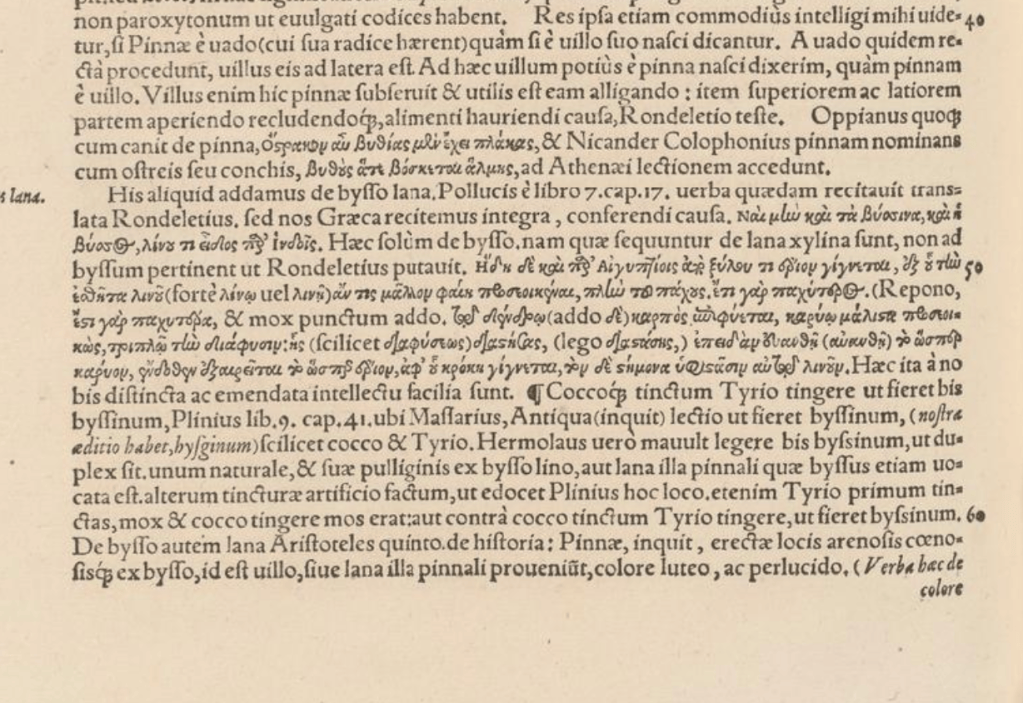
Van der Feen records Aldrovandus agreeing with Gesner in 1606. In 1910, D’Arcy Wentworth Thompson’s English translation makes the pinna grow straight up from its anchoring fibres.6
Thompson gives his reasons in a footnote. He sets the two alternatives out in Greek, changing the article along with the noun: masculine ἐκ τοῦ βυσσοῦ, “out of deep water,” or feminine ἐκ τῆς βύσσου, “from its byssus, or tuft of anchoring fibres.” He names commentators who accept depth, cites Athenaeus on that side, and quotes Gaza on the other.
Then he pictures the animal. The tuft is the pinna’s characteristic feature, and the shell grows upright from it. It lives in deep water, Thompson reasons, but can’t be said to grow up out of that water. This is his chief reason for preferring the fibre reading.
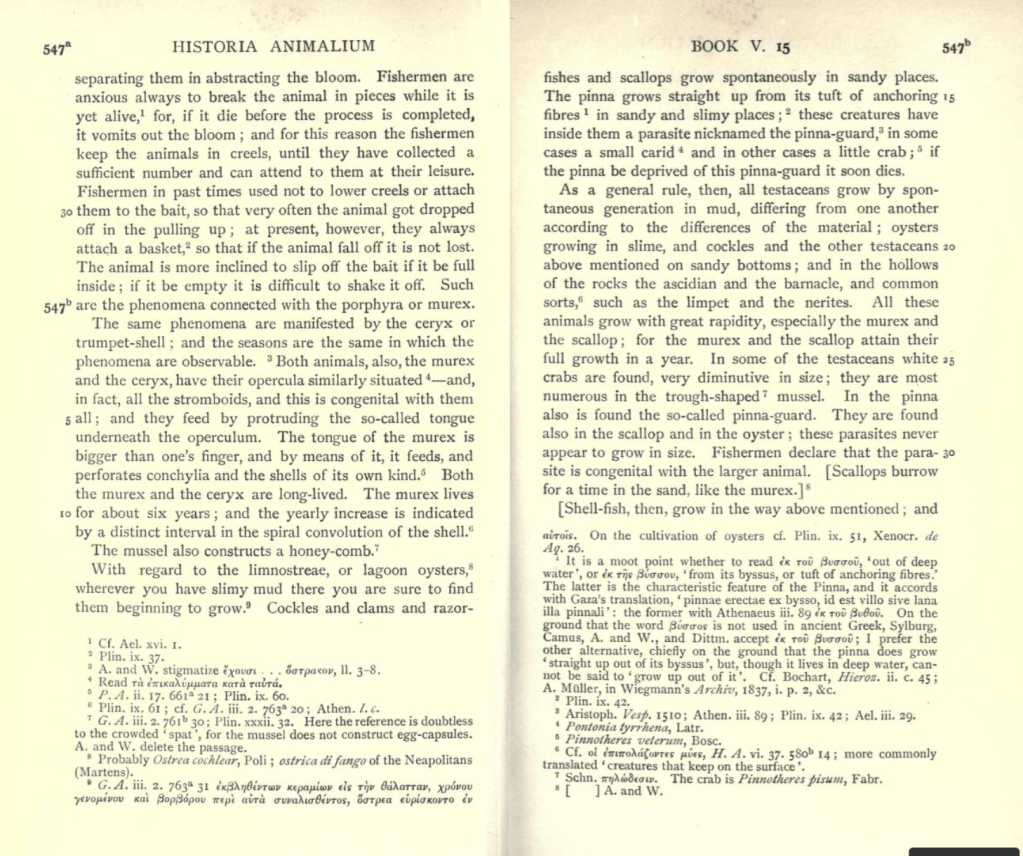
Both arguments ask the reader to picture a pinna. Gesner describes a shell standing on the seabed with a tuft at its side; Thompson describes a shell rising from its attachment. Each weighs the grammar and brings the animal to bear on it. Their pictures support opposite readings.
But Thompson’s “out of deep water” isn’t quite Moerbeke’s ex fundo, “from the bottom.” A shell needn’t emerge from the water to grow upright from the seabed. In this footnote, Thompson’s objection to emerging from deep water doesn’t answer the reading “from the bottom.”6
The surrounding passage supports the bottom reading: oysters arise in slime, other shellfish in sand, others in hollows of rock. These are accounts of spontaneous generation as well as descriptions of habitat. The phrases overlap, but they needn’t duplicate each other: “from the bottom” names where the shell grows from; “in sandy and muddy places” describes the ground.
The choice remains in the freely available transcription of Thompson’s translation at MIT’s Internet Classics Archive. Open Book V: the pinna still grows from its anchoring fibres.6
Van der Feen accepts byssus as established zoological terminology. Naming the fibres and translating Aristotle have become separable matters. On the London fragment’s label, the word names the shell’s anchoring fibres. Microscopy supported that identification.
The researchers compared that fragment’s fibres with a modern sea-silk reference sample. Wear and matting kept some details beyond reach: they couldn’t reconstruct the exact weave or identify the animal whose fine coat fibre formed the back. They proposed an eighteenth-century Italian origin and a possible waistcoat.1
At one folded edge, silk stitches remain. At the next, there are empty stitch holes. Someone joined this small piece to something larger.
Sources and notes
- Felicitas Maeder, Penelope Walton Rogers and Margarita Gleba, “A mysterious little piece: A compound-weave textile incorporating sea silk from the Natural History Museum, London,” Archaeological Textiles Review 61 (2019), 114–121. Construction and processing: 115–117; fibre examination: 117–120; proposed date and garment use: 114, 120. The label’s date has not been established. The proposed date and garment use remain hypotheses, not findings of the fibre analysis.
- Felicitas Maeder, “Irritating Byssus: Etymological Problems, Material Facts, and the Impact of Mass Media”, in Textile Terminologies from the Orient to the Mediterranean and Europe, 1000 BC to 1000 AD (2017), 500–519. See especially p. 513 and notes 102–103 for Aachen. The leaflet and Bock’s examination are reported through Maeder; no direct transmission from Gaza or Thompson to the leaflet is asserted. The historical textile term is not treated as having a single fixed meaning in every source.
- P. J. van der Feen, “Byssus,” Basteria 13(4) (1949), 66–71. Greek distinction: 66–69; Moerbeke, Gaza and the explanatory addition: 68; Rondelet, Gesner and later objections: 69–70. Gaza and Moerbeke are quoted through van der Feen, not from an independent examination of their target leaves. His universal claim that later zoological usage derives from Gaza is his historical conclusion, not a corpus-wide finding independently established for this essay. He allows a corrupt copy or inattention to gender and accent as possible explanations of Gaza’s reading; neither is established here. The surrounding Aristotelian discussion includes spontaneous generation, so “grows from” should not be treated as an unambiguously modern biological description.
- Pieter Beullens and Allan Gotthelf, “Theodore Gaza’s Translation of Aristotle’s De Animalibus: Content, Influence, and Date,” Greek, Roman, and Byzantine Studies 47 (2007), 469–513, especially 469–472. These passages establish broad circulation and editorial method, not the cause of the particular byssus reading or a complete explanation of its later persistence. Moerbeke’s publication history is reported by van der Feen, p. 68. The 1476 printers were Johannes de Colonia and Johannes Manthen.
- Conrad Gesner, Historiae animalium, book IV, the aquatic volume (Zurich: Christoph Froschauer, 1558), 864; context on 862–865. Gesner’s reference to book V, chapter 13 is to Aristotle, not his own volume; the modern locator is Historia animalium V.15, around Bekker 547b. Normalized transcription: Ad haec villum potius è pinna nasci dixerim, quàm pinnam è villo. Working translation prepared for this essay. Long s and u/v are normalized in transcription; “I would say” preserves the qualification in dixerim. The supplied image retains the original lettering.
- Aristotle, Historia animalium, trans. D’Arcy Wentworth Thompson, The Works of Aristotle, vol. IV (Oxford: Clarendon Press, 1910), V.15, Bekker 547b15, footnote 1. Digitized volume. Thompson explicitly prints the alternative articles τοῦ and τῆς. His English gloss for the masculine reading is “out of deep water”; he also quotes Athenaeus’s βυθοῦ without translating it separately. Neither “bottom” nor fundum appears in this footnote. The comparison with Gesner and the distinction between “deep water” and “the bottom” are this essay’s readings of the passage, not evidence of a direct exchange or an account of Thompson’s position elsewhere. The redundancy counterargument is also ours, not Thompson’s. The Internet Classics Archive transcription of Book V was checked in September 2026; its availability does not establish the reading’s prevalence.

